Label Material Guide: Paper, PP, PE or Polyester Labels
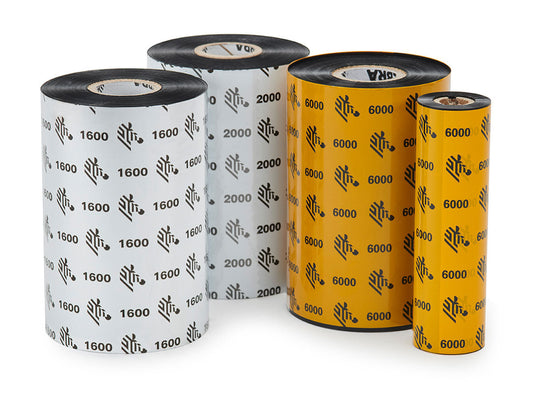
Most label failures we see are not printer faults. The barcode smears off a polypropylene label because it was printed with a wax ribbon, or a paper label peels off a chilled crate because the adhesive was never meant for cold. This label material guide matches the face stock, the adhesive and the ribbon to the job, using rolls and Zebra ribbons we stock, so you order the right combination the first time.
Which label material and ribbon should you order?
| Your situation | Label material | Ribbon |
|---|---|---|
| Shipping labels, used within days | Direct thermal paper | None |
| Shelf, carton and product labels kept indoors for months | Thermal transfer paper, semi-gloss or matte | Zebra 2300 wax, 02300GS11007 |
| Labels handled often, or exposed to damp, light oil or condensation | Polypropylene (PP), for example 100x50 mm white PP, acrylic adhesive | Zebra 3200 wax/resin, 03200GS11007 on matte PP, resin on gloss PP |
| Squeezable bottles, tubes and tight curves | Polyethylene (PE) | Wax/resin or resin, test on the actual film |
| Asset tags, rating plates, cleaning chemicals, heat | Polyester (PET), for example 50x25 mm matt white PET | Zebra 5095 resin, 05095GS08407 (84 mm) or 4800 resin |
| Cold, rough or dusty surfaces such as chilled crates and recycled cardboard | Paper or PP with rubber (hot-melt) adhesive, for example 50x30 mm with rubber glue | Depends on face stock, as above |
Every ribbon above is ink side out (the "Out" in the product title). Pick a ribbon at least as wide as the label so the printhead never runs on bare liner.
Direct thermal or thermal transfer: which label material lasts?
Direct thermal labels carry a heat-sensitive coating that darkens under the printhead. There is no ribbon to buy, which is why they dominate shipping labels. The coating keeps reacting to heat and sunlight, so a direct thermal label on a sunny window or a warm dashboard fades. For anything that must stay scannable for more than a few months, use thermal transfer.
Thermal transfer labels have no active coating. The printer melts ink from a ribbon onto the face stock, and the durability depends on how well that ink and the surface suit each other. That pairing is where most mistakes happen.
Paper, PP, PE or polyester: what does each face stock do?
| Face stock | Strengths | Weak points | Typical use |
|---|---|---|---|
| Coated paper (eco, top, semi-gloss, matte) | Cheapest, prints sharply, easy to write on | Tears, absorbs water, no chemical resistance | Shelf labels, cartons, price labels, shipping |
| Polypropylene (PP) | Water and oil resistant, does not tear easily, good value for a synthetic | Gloss PP needs resin ribbon, less heat tolerant than PET | Cosmetics, food packaging, chilled goods, warehouse bins |
| Polyethylene (PE) | Soft and conformable, follows squeezed or curved surfaces | Stretches, more sensitive to ribbon choice | Squeeze bottles, tubes, drums with tight radius |
| Polyester (PET) | Dimensionally stable, resists heat, abrasion and many chemicals | Highest price, stiff on tight curves | Asset tags, rating plates, electronics, laboratory |
"Eco" and "top" on paper labels refer to the coating. An eco label is typically direct thermal with no protective topcoat. A top-coated label adds a protective layer that holds up better to handling and moisture. Semi-gloss and matte labels in our range are mostly thermal transfer paper. Read the product title: it states direct thermal or thermal transfer.
Which thermal transfer ribbon matches which label material?
Zebra's own ribbon specifications draw the lines clearly, and they match what we see in support tickets.
| Zebra ribbon | Type | Zebra lists it for | Smear and scratch resistance |
|---|---|---|---|
| 2300 | Wax | Coated and uncoated paper, tags | Low |
| 3200 | Wax/resin | Coated and uncoated paper, matte synthetics | Medium |
| 3300 | Wax/resin | Coated and uncoated paper, matte synthetics (desktop, up to 6 ips) | Medium |
| 4800 | Resin | Gloss paper, matte and gloss synthetics | High |
| 5095 | Resin | Gloss paper, matte and gloss synthetics | High |
Source: Zebra thermal ribbons specification sheet.
The practical rules that follow from that table:
- Wax on paper only. Wax sits on top of the surface. On a smooth synthetic it has nothing to key into and wipes off with a thumb.
- Wax/resin is the safe middle. It covers paper and matte PP, resists light handling, and costs less than resin. If you print a mix of paper and matte synthetic labels on one printer, 3200 is usually the ribbon to stock.
- Gloss synthetics need resin. Zebra's PolyPro 3000T Gloss label sheet names 4800 and 5095 as the recommended ribbons, not a wax/resin.
- Resin is not solvent-proof. Zebra's chemical tests show 4800 and 5095 surviving many cleaners, oils and isopropyl alcohol, but neither is recommended for acetone or xylene. If your labels meet strong solvents, test before you buy a pallet.
Resin also prints slower: Zebra rates 4800 and 5095 at up to 6 inches per second, against 10 to 12 for 2300. On a busy despatch line that matters, which is another reason not to default to resin for paper labels.
Acrylic, rubber or removable: which label adhesive holds?
The adhesive is the part buyers forget, and the part that decides whether the label is still on the box next week.
| Adhesive | Behaviour | Choose it for |
|---|---|---|
| Permanent acrylic | Builds strength over the first day, ages well, resists UV and moisture once set | General product, shelf and shipping labels at room temperature |
| Rubber (hot-melt) | High initial grab, sticks to rough, dusty and cool surfaces | Corrugated and recycled cardboard, crates, chilled goods |
| Removable | Peels off cleanly within a limited time | Price labels, temporary bin or returns labels |
| Freezer grade | Formulated to bond at low application temperatures | Labels applied inside cold stores or onto frozen product |
Two numbers on a label specification decide cold-chain jobs: the minimum application temperature and the service temperature range. They are not the same thing. Zebra's PolyPro 3000T Gloss, for example, has a minimum application temperature of 5 °C but a service range of -20 °C to 80 °C once applied and left to set, which Zebra quotes as typically 24 hours. Put it on a warm product and freeze it later, and it holds. Apply it to a pallet already sitting at -18 °C, and it will not. For labelling inside a freezer, buy a freezer-grade adhesive and check its minimum application temperature.
What goes wrong, and how do you spot it?
- Barcode smudges when rubbed: ribbon too soft for the face stock. Move from wax to wax/resin, or from wax/resin to resin.
- Print is patchy or grey on a synthetic label: the ribbon and label are not a matched pair, or darkness is too low for resin. Raise darkness in small steps before changing media.
- Label lifts at the corners on a bottle: face stock too stiff for the curve. Swap PET or PP for PE.
- Label falls off chilled crates: acrylic applied cold. Use rubber or freezer-grade adhesive.
- Label goes black or grey in a warm van: it is direct thermal. Use thermal transfer paper for anything with a long life.
- Ribbon wrinkles or prints nothing: check the ink side matches your printer. Our separate guide on Zebra ribbon part numbers explains how to read the winding code.
Common questions
Can I use a wax ribbon on polypropylene labels?
Not if the labels will be handled. Zebra lists 2300 wax for paper only. Use 3200 wax/resin on matte PP and a resin ribbon on gloss PP.
Are polyester labels worth the extra cost?
For asset tags, rating plates and labels that meet heat, abrasion or cleaning chemicals, yes. For a carton that is opened within a week, paper is fine and far cheaper.
Do I need resin ribbon for paper labels?
Usually not. Wax or wax/resin on paper gives a sharp, scannable print at higher speed. Resin on paper makes sense only on gloss paper or where the label must survive scrubbing.
What is the difference between eco and top-coated thermal labels?
Both are direct thermal paper. Top-coated labels add a protective layer against moisture, grease and handling. Eco labels skip it and suit short-life uses such as parcel labels.
Which label material survives a freezer?
PP or a top-coated paper with a freezer-grade or rubber adhesive, applied above the adhesive's minimum application temperature. Check the service temperature range on the label specification.
Order the matched set
Browse the full range of labels by size, face stock and adhesive, then pick the matching ribbon from our thermal transfer ribbons. Before ordering, check three things against your printer: ribbon width, ribbon length (74 m on most desktop models, 300 m or 450 m on industrial ones) and ink side.
Tags:
Previous
Which Receipt Printer for Which Counter: 2026 Shortlist
Next
GPSR Labelling: Which Label Printer Prints Compliant Labels