Handheld Terminal Scan Engines: Which Range to Order
A new terminal arrives, the first pallet label at the top of the racking will not decode, and the device goes back in its box. The terminal model was right. The scan engine inside it was not. A handheld terminal scan engine is fixed at the factory, it is selected by a single character in the part number, and getting it wrong is the most common reason a mobile terminal order has to be returned.
Range is a property of the engine, not of the terminal. The gap between the cheapest and the dearest class is the difference between 24 centimetres and 32 metres. Below are the manufacturer decode distances for each class, the engine fitted to each model we stock, and a plain answer on when the cheaper engine is the better buy.
Which scan engine should you order?
| Your situation | Range class | Order this |
|---|---|---|
| Shop counter and stockroom, products and phone screens at arm's length | Standard range (SE4710) | Zebra TC22, WLMT0-T22B6ABC2-A6 |
| Delivery, service and field work, labels and paperwork in the hand, 5G needed | Standard range (SE4770) | Zebra TC58e SE4770, TC58BE-3T1J6B1A80-A6 |
| Warehouse picking: shelf fronts plus pallet labels up to roughly 7 metres | Advanced range (SE55, listed as SE5500) | Zebra TC53e SE5500, TC530E-0T1K6B1000-A6 |
| High racking, bulk storage and yard, labels well beyond 10 metres | Extended range (SE58, listed as SE5800) | Zebra MC9400, MC9401-0G1M6HSS-A6 |
| Dot peened, laser etched or cast codes on metal and plastic parts | Direct part marking | Datalogic PowerScan PD9531-DPM, not a terminal engine |
Why does the terminal model not tell you the range?
The terminal model sets the screen, the battery, the keypad, the sealing and the Android build. The scan engine is a separate module inside it: optics, illumination, aimer and decoder. The same terminal is sold with two or three different engines, at different prices, under part numbers that differ by one letter. A TC53e with an SE4720 and a TC53e with an SE5500 are the same computer with a twenty-fold difference in reach.
That is why every terminal listing in our mobile terminals range names the engine in the title and again on the Scanner Type line of the specification block. Buying on model name alone is a coin toss on range.
One naming quirk causes a lot of confusion. Zebra publishes its OEM engines as SE4710, SE4770, SE55 and SE58. When the same engine is fitted inside a terminal, part numbers and listings usually spell the longer-range ones SE5500 and SE5800. Read SE55 and SE5500 as advanced range, SE58 and SE5800 as extended range.
How far does each range class actually read?
Decode distance depends on the bar width of the code, measured in mils (thousandths of an inch), far more than on the device. A 100 mil pallet label and a 5 mil component label are read by the same engine at wildly different distances. These are the manufacturer figures for the three classes we stock.
| Barcode | Standard range (SE4710) | Advanced range (SE55 / SE5500) | Extended range (SE58 / SE5800) |
|---|---|---|---|
| 5 mil Code 39 | 6.1 to 24.1 cm | 6.4 to 67.6 cm | 5.3 cm to 1.45 m |
| 10 mil Data Matrix | 7.5 to 22.9 cm | 5.6 to 68.8 cm | 6.1 cm to 1.58 m |
| 13 mil UPC (100 per cent) | up to 61 cm | 6.4 cm to 1.80 m | 5.6 cm to 3.71 m |
| 20 mil Code 39 | 5.1 to 66.0 cm | up to 2.77 m | up to 5.99 m |
| 55 mil Code 39 | not rated | up to 7.44 m | up to 18.64 m |
| 100 mil Code 39 | not rated | up to 14.07 m | up to 32.64 m |
| Overall working range | close range only | 5.6 cm to over 12.2 m | under 5 cm to over 32 m |
Figures come from the Zebra SE55 specification sheet and the matching SE58 and SE4710 sheets. They are laboratory figures on good print. Plan for less in a real aisle: shrink wrap, condensation in a chiller, a label curled around a pallet corner and a worn printhead all cut the far distance before anything else does.
Why is the longest range not automatically the right choice?
Four reasons, and they come up on site constantly.
The near field gap. Long range optics need standoff. The SE55 needs 18.2 cm of air before it will read a 15 mil Code 128. Hold a wide label flat against the scan window and nothing happens. Operators read that as a faulty device.
Aiming precision. At 18 metres the aimer dot covers more than one label. The engine decodes something, the picker confirms it, and the wrong pallet is booked. Beyond about 10 metres you need labels spaced far enough apart that a mis-aim is physically impossible, or a laser aimer the operator trusts.
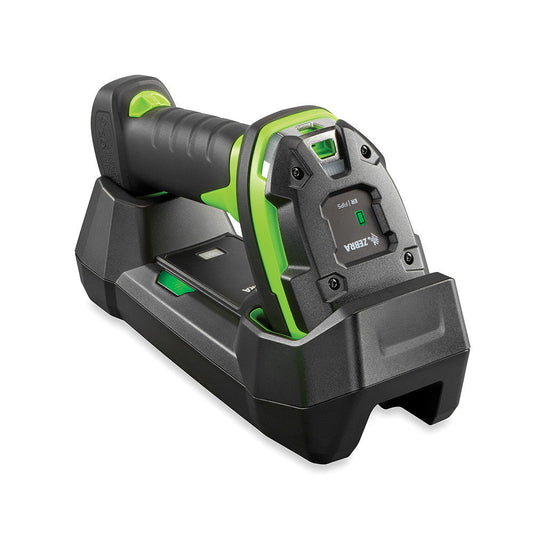
Form factor. Extended range engines are offered in the large pistol grip bodies: a 7000 mAh battery, a trigger, a 4.3 inch screen. That is the right tool in a 12 metre aisle and the wrong tool for a courier who also needs a signature and a camera.
Focus time. A focusing engine spends a moment working out distance on every trigger pull. Across 1200 close-range picks a shift that is real time. On a till it is noticeable.
The honest answer for most retail and counter work is the standard range engine. If nothing you scan sits above head height, the money is better spent on battery capacity, a spare battery and a longer warranty than on reach you will never use.
Does any terminal engine read direct part marks?
No. Direct part marking means a code dot peened, laser etched, chemically etched or cast into metal or plastic. There is no ink and almost no contrast, the surface is often curved and specular, and decoding depends on illumination hitting the marks at the right angle. Standard, advanced and extended range engines are all built for printed labels and screens.
If you read marked parts, the terminal handles the application and a dedicated DPM reader handles the code. The Datalogic PowerScan PD9531-DPM is the corded option, the PBT9501-DPM the cordless one, and the Newland NVH220 the budget entry; all three sit in our barcode scanners range. Ordering a long range terminal in the hope it will cope with etched codes is the most expensive way to discover that range and contrast are separate problems.
What should you measure before raising the order?
- Longest real scan distance. Stand where the operator stands and measure to the furthest label actually scanned, not to the top of the racking.
- Shortest distance. Does anyone scan a label pressed flat against the device? If yes, note the widest code that happens to.
- Narrowest code and symbology. Get the X dimension in mils from whoever prints the labels. Two dimensional codes lose range far faster than linear ones.
- Print quality and substrate. Direct thermal labels fading in a chiller, laminate glare and shrink wrap all cost you distance.
- Temperature. A freezer operation needs the freezer variant, not just a long engine.
- Scan mix. Count how many scans per shift happen at each distance band.
A workable rule: if more than roughly one scan in twenty sits beyond 3 metres, specify advanced range as the minimum. If a meaningful share sits beyond 10 metres, specify extended range and accept the pistol grip body.
Which ruggedness figures matter alongside the engine?
Range is useless on a device that will not survive the aisle. The MC9400 is rated IP65, and IP68 with the battery fitted, tested to a 3.65 metre drop onto concrete (2.1 metres on the freezer version), 6000 tumbles from 1 metre, and an operating range of minus 20 to plus 50 degrees Celsius, or minus 30 to plus 50 on the freezer build, per the Zebra MC9400 specification sheet. The TC53e, TC58e and TC22 are rated IP65, which is correct for retail, delivery and ordinary warehouse use but is not a freezer or a foundry specification.
Common questions
Can the scan engine be changed after delivery? Engine kits exist and a service centre can fit one, but between parts, labour and the device being away, it normally costs more than ordering the correct variant did. Treat the engine as permanent and specify it properly once.
Does a long range engine read 2D codes as far as 1D codes? No, and the drop is steep. The extended range SE58 reads a 100 mil Code 39 at 32.64 metres, a 55 mil QR code at 7.32 metres and a 10 mil Data Matrix at 1.58 metres. If your long distance labels carry Data Matrix or QR, size the engine on the 2D figure, never the Code 39 headline.
What range do I need for GS1 DataMatrix at the till? Standard range. Retail GS1 DataMatrix is small and read at roughly 10 to 25 centimetres, which every engine class covers. The 2D question at the till is whether the engine is an imager at all, not how far it reaches.
SE55 or SE58 for 8 metre racking? If the pallet labels are wide, 55 mil or more, advanced range reaches 7.44 metres on 55 mil Code 39 and 14.07 metres on 100 mil, so the SE55 class is enough. If the labels at height are narrower than that, or you also scan across a yard, go extended range.
Does our ERP or WMS need configuring per engine? No. The engine presents decoded data to the application through DataWedge or a keyboard wedge, so the software does not know which engine sent it. What does need attention is the DataWedge profile: enable only the symbologies you use, because leaving everything on slows decoding and invites mis-reads.
Can a phone camera replace a scan engine? At a counter, for a handful of scans a day, sometimes. For thousands of scans, codes beyond an arm's length, poor light, gloves or a dusty aisle, no. A camera focuses slowly, has no trigger and has no aimer.
Ordering
Decide the range class first, then pick the body around it. Standard range for counters, stockrooms and delivery rounds; advanced range for mixed picking where labels sit above head height; extended range for high bay, bulk and yard work; a separate DPM reader for marked parts. The full range is in mobile terminals and handheld terminals, with triggers, holsters, charging cradles and spare batteries in barcode scanner accessories. If you measured the distances and the figures above still leave the decision close, send us the numbers and the label specification and we will tell you which engine we would put on the order.
Tags:
Previous
Zebra GK420d Replacement: Which Label Printer to Order
Next
Rugged Tablet Troubleshooting: Touch, Battery and Docks